
System Transformation

RREVIVAL ORGANIZATIONAL SYSTEM TRANSFORMATION
Why System Transformation Fails, And What Actually Makes It Work
Have you ever struggled with transformation in your organization?
Change management is everywhere. It is presented as structured, controlled, and often even predictable. Yet reality tells a different story: many transformation initiatives fall short of expectations or fail entirely.
The Reality of Transformation
Let’s be honest from the start.
Transformation is:
Complex
Energy-intensive
Emotionally demanding
Not only for leadership, but for everyone involved.
Human beings naturally tend to prefer stability over change. As Kurt Lewin, one of the pioneers of organizational change theory, highlighted, systems are held in equilibrium by forces resisting change. Even when people complain about the status quo, they often resist leaving it behind.
Why Transformation Often Fails
From experience across multinationals, NGOs, and SMEs, a recurring pattern emerges:
👉 Organizations approach transformation too narrowly.
They focus on structure.
Or strategy.
Or culture.
But rarely all of it together.
As John Kotter emphasizes in his work on transformation, failure often stems from not addressing the system as a whole—especially culture and leadership alignment.
Transformation Is a System, Not a Project
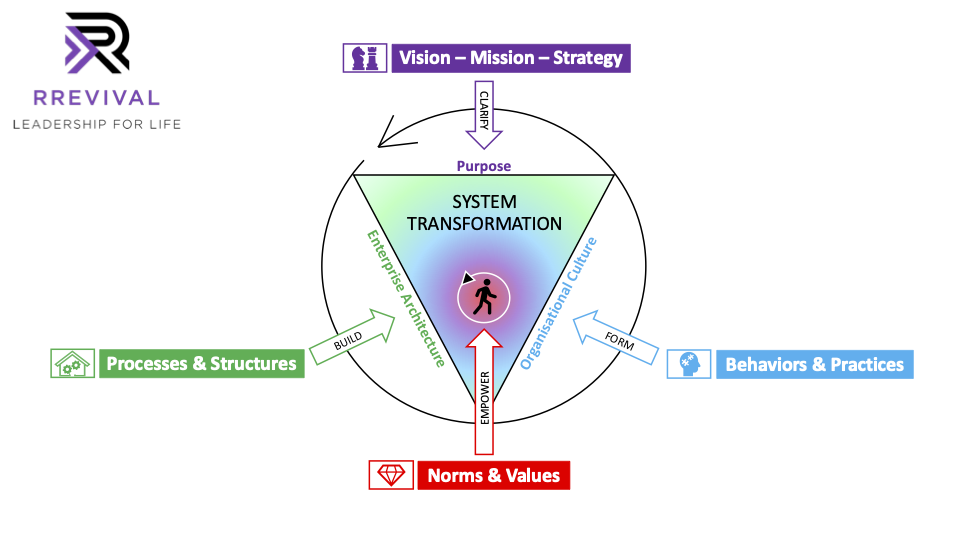
Rrevival Organizational System Transformation
At Rrevival, we approach transformation as an interconnected system.
Our Rrevival framework is built on three essential dimensions:
1. Purpose
Vision
Mission
Strategy
Purpose defines why the organization exists. Without clarity here, transformation lacks direction.
2. Enterprise Architecture
Processes
Structures
These define how the organization operates. Even the best strategy fails if processes and structures are misaligned.
3. Organizational Culture
Behaviors
Practices
Culture determines how people actually act. As Peter Drucker famously said:
👉 “Culture eats strategy for breakfast.”
The Foundation: Norms and Values
What truly enables transformation is often overlooked:
💡 Norms and values
They shape behaviors.
They influence decisions.
They determine whether change is embraced—or rejected.
Edgar Schein’s work on organizational culture reinforces this: underlying assumptions and values are the deepest level of any system and the hardest—but most critical—to transform.
The Key Insight
Successful transformation requires alignment across all dimensions:
Purpose (why)
Architecture (how)
Culture (how people behave)
Supported by:
Norms & values
Behaviors & practices
Processes & structures
Vision, mission & strategy
When these elements reinforce each other, transformation becomes sustainable.
The Outcome
When done right:
✅ People thrive
✅ Engagement increases
✅ Performance improves
✅ Organizations become more resilient and successful
Because ultimately:
👉 If people thrive in their work, the organization thrives.
Final Thought
Transformation is not about managing change.
It is about aligning a system.
And that is exactly where most organizations underestimate the challenge—and the opportunity.